
7 European cloud providers vs AWS: real pricing, real trade-offs (2026 guide)
European cloud providers now deliver 2 to 8 times more compute per euro than AWS on-demand (up to 14x on a performance-per-euro basis), charge nothing for data egress, and operate outside the CLOUD Act. We compared seven of them on pricing, performance, managed services, and sovereignty certifications. With real numbers.
TL;DR
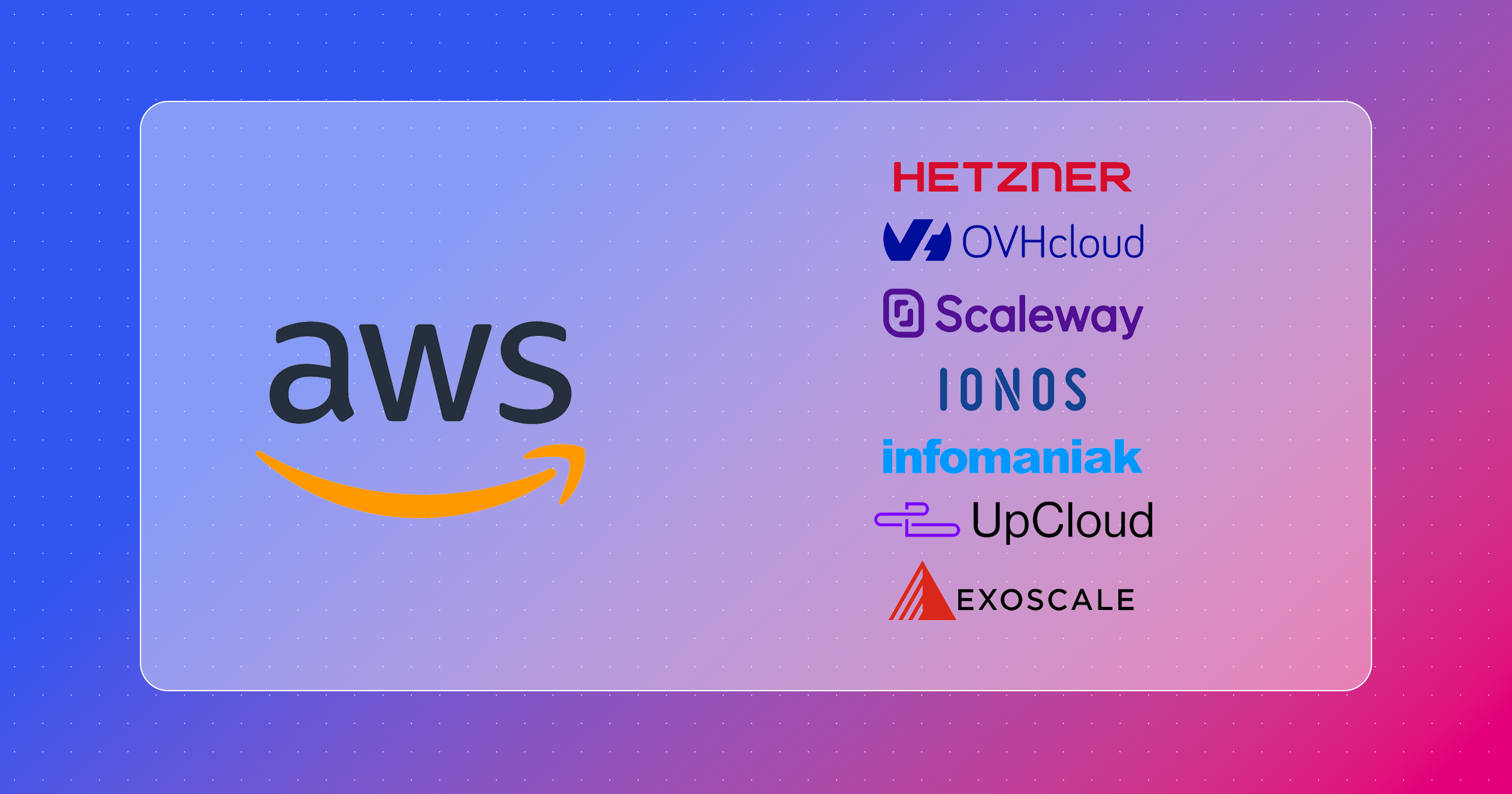
AWS charges European companies a steep premium for running workloads in Europe, and the real cost trap is egress: 1 TB of outbound data costs about 83 dollars per month on AWS, versus zero on Hetzner, OVHcloud, and Infomaniak. We compared seven European cloud providers (Hetzner, OVHcloud, Scaleway, IONOS, Infomaniak, UpCloud, Exoscale) across pricing, managed services, sovereignty certifications, and honest trade-offs. Hetzner delivers 14.3x more compute value per euro. OVHcloud is SecNumCloud-certified and crossed 1 billion euros in revenue. Scaleway is the closest to a full AWS alternative with serverless, GPU, and AI services. The managed services gap is narrowing fast, but AWS still wins on breadth. For most European scale-ups, the question is no longer if you should consider EU cloud, but which provider fits your workload.
A typical European startup running a modest web application on AWS pays about 169 dollars per month. The same workload on Hetzner costs 20 euros. On Infomaniak, 10 euros. The difference is not a rounding error. It is a strategic decision that compounds every month, across every instance, for the life of your company.
European cloud providers have quietly become very good. Not at everything, not for every workload, but good enough that ignoring them is now the expensive choice. Gartner projects 80 billion dollars in sovereign cloud IaaS spending globally in 2026. The EU Data Act eliminates all cloud switching fees by January 2027. And in October 2025, a single AWS outage in Virginia knocked out HMRC and UK banking services for hours, prompting a fundamental question: why are critical European services dependent on a data center on the east coast of the US?
We compared seven European cloud providers against AWS on the things that actually matter: compute pricing, egress costs, managed services, sovereignty certifications, and honest weaknesses. No cheerleading. No vendor bias. Just the numbers.
What you are actually paying on AWS in Europe
Before comparing alternatives, let's establish the baseline. In eu-central-1 (Frankfurt), an m6i.large (2 vCPU, 8 GB) costs around 70 to 80 dollars per month on-demand (exact price varies by region). The workhorse m6i.xlarge (4 vCPU, 16 GB) costs roughly 140 to 155 dollars. S3 Standard storage runs 0.023 dollars per GB per month. EBS gp3 volumes cost about 0.08 to 0.09 dollars per GB.
The real cost trap is egress. After a free tier of 100 GB per month, AWS charges 0.09 dollars per GB. One terabyte of monthly outbound data costs about 83 dollars. This single line item can represent a significant portion of the total bill for data-heavy workloads. Most European providers charge nothing for egress.
A representative workload (2 vCPU, 8 GB RAM, 100 GB SSD, 1 TB egress per month) comes to roughly 169 dollars per month on AWS. Stack on EKS at 73 dollars per month for the control plane, a managed PostgreSQL at 60 dollars, and a load balancer at 22 dollars, and you are well above 300 dollars before your application handles a single request.
The fine print: nobody actually pays on-demand
To be fair, most companies on AWS do not pay on-demand prices. Reserved Instances (1-year, all upfront) cut compute costs by 35-40%. Savings Plans offer similar discounts with more flexibility. An m6i.large with a 1-year RI drops to roughly 45 to 50 dollars per month. With a 3-year commitment, closer to 30 to 35 dollars.
But egress fees are never discounted. That 83 dollars per TB stays the same whether you are on-demand or reserved. And the European providers in this comparison do not require 1-3 year commitments to reach their listed prices. Hetzner at 15.99 euros is month-to-month, no commitment. So the honest comparison is: even against AWS with a 1-year Reserved Instance, European providers are still 2-5x cheaper on compute, and infinitely cheaper on egress. The gap narrows with commitments but never closes.
1. Hetzner: 14.3x more compute per euro, and it is not even close (Germany)
Founded: 1997. HQ: Gunzenhausen, Germany. Private, family-owned. Data centers: Falkenstein, Nuremberg, Helsinki, Ashburn, Hillsboro, Singapore. Certifications: ISO 27001, BSI C5 Type 2.
The February 2026 Callista benchmark, published by Swedish consultancy Callista Enterprise, tested a game server workload across five EU providers and AWS. Hetzner's CPX32 (4 vCPU, 8 GB) scored 71% higher on Geekbench multi-core than AWS's c6i.xlarge while costing 16.36 euros versus 162.88 euros. That yields 14.3x more compute performance per euro spent. To be clear: this is a value ratio (performance divided by price), not a claim that Hetzner is 14x cheaper. On pure price, a comparable Hetzner instance costs roughly 5-8x less than the equivalent AWS on-demand. Still enormous.
The dedicated CCX line is where production workloads go. A CCX13 (2 vCPU, 8 GB, 80 GB SSD) costs 15.99 euros per month after the April 2026 price increase. A CCX23 (4 vCPU, 16 GB) runs 31.49 euros. Both include 20 TB of outbound traffic at no charge. Overage costs 1 euro per TB. That same 1 TB egress that costs 83 dollars on AWS costs nothing on Hetzner.
Even after Hetzner's announced 25-37% price hike effective April 2026, driven by DRAM and NAND shortages, the prices remain 5-10x below AWS.
The honest trade-off: No managed databases. No serverless compute. No CDN. No AI services. No container registry. Managed Kubernetes exists (control plane free), but that is the only higher-level service. Teams choosing Hetzner must self-manage everything or use third-party tools. For engineering-strong teams running containerized workloads, this is fine. For teams expecting AWS-like managed services, it is a dealbreaker.
2. OVHcloud: Europe's sovereign cloud incumbent, now at 1 billion euros (France)
Founded: 1999. HQ: Roubaix, France. Revenue: 1.084 billion euros (FY2025). Employees: ~3,200. Customers: 1.6 million. Data centers: 44+ across 4 continents. Certifications: SecNumCloud 3.2, ISO 27001, SOC 1/2/3, HDS, PCI DSS.
OVHcloud is the only European-born provider that operates at hyperscaler-adjacent scale. Over 44 data centers across 4 continents (with new locations opening in 2026). Over 450,000 servers deployed. Its SecNumCloud 3.2 qualification, covering Private Cloud across three French data centers, makes it the default choice for French government and defense contracts.
In December 2025, OVHcloud eliminated all egress fees from Object Storage. No charges on outbound bandwidth, across all storage classes, all regions, all destinations, including transfers to competing providers. No API call fees either. Combined with unlimited free egress on dedicated servers, OVHcloud is now the most egress-friendly option after Hetzner.
A b3-8 instance (2 vCPU, 8 GB) costs roughly 37 euros per month. A b3-16 (4 vCPU, 16 GB) runs about 75 euros. Managed Kubernetes has a free control plane. Managed databases cover PostgreSQL, MySQL, MongoDB, Valkey, Kafka, and OpenSearch.
Founder Octave Klaba returned as CEO in October 2025, signaling renewed focus on product and scale. But the company faces margin pressure from rising hardware costs, with 9-11% price increases across most product lines from April 2026.
The honest trade-off: No serverless compute (no Lambda equivalent). No native CDN. Support quality remains a frequent criticism at lower tiers. The March 2021 Strasbourg fire still shadows OVHcloud's reputation among risk-conscious buyers, though infrastructure has been substantially upgraded since.
3. Scaleway: the closest thing to a European AWS (France)
Founded: 1999 (rebranded 2015). HQ: Paris, France. Parent: Iliad Group (10.3 billion euros revenue). Data centers: Paris (5 DCs), Amsterdam, Warsaw, Milan, Germany. Certifications: ISO 27001, HDS. SecNumCloud in progress.
Scaleway is backed by Xavier Niel's 3 billion euro Iliad Group investment in cloud and AI. It serves as infrastructure partner for Mistral AI, Hugging Face, and Kyutai, and was selected by NVIDIA to join the DGX Cloud Lepton platform. Its DC5 facility houses nearly 5,000 GPUs, with NVIDIA Blackwell B300-SXM instances launching in 2026.
The product catalog is the most AWS-like among European providers: serverless compute (Functions, Containers, Jobs), managed Kubernetes (Kapsule, free control plane), managed databases (PostgreSQL, MySQL, Redis, MongoDB, ClickHouse, Serverless SQL), Generative APIs, Managed Inference, object storage, and a full networking stack. No other European-born provider offers serverless in the Lambda paradigm.
Compute pricing is competitive. An ARM-based BASIC2-A4C-16G (4 vCPU, 16 GB) costs roughly 50 euros per month. Bandwidth is included with instances. The Callista benchmark rated Scaleway at 4.8x the value per euro of AWS.
The honest trade-off: European regions only (no global presence). Smaller support organization than OVHcloud or AWS. SecNumCloud qualification is in progress but not yet obtained. No independent revenue disclosure. For teams that need the full managed services stack without leaving Europe, Scaleway is the strongest option.
4. IONOS: the German enterprise choice that nobody talks about (Germany)
Founded: 1988. HQ: Montabaur, Germany. Parent: IONOS Group SE (United Internet AG). Revenue: 1.56 billion euros (FY2024). Customers: 6.32 million. Certifications: ISO 27001, BSI C5, BSI IT-Grundschutz, SOC 1/2/3, GAIA-X.
With 1.56 billion euros in revenue, IONOS is actually larger than OVHcloud. The 1&1 descendant offers the broadest managed services portfolio among German providers: managed Kubernetes, PostgreSQL, MariaDB, MongoDB, In-Memory DB, Apache Kafka via Event Streams, CDN (99 euros per month), load balancers, private container registry with vulnerability scanning, and an AI Model Hub with LLM access (Llama, Mistral) from 0.10 euros per million tokens.
Its Data Center Designer, a visual drag-and-drop infrastructure builder, is genuinely unique and appeals to enterprise IT teams more comfortable with network diagrams than CLI tools.
Pricing uses a granular per-component model. A pre-configured Memory Cube M (4 vCPU, 16 GB) costs roughly 23 euros per month. Egress includes 2 TB free monthly, with overage at 0.03 euros per GB.
IONOS holds both BSI C5 and IT-Grundschutz certifications. The German Federal IT Center (ITZBund) is a customer, and IONOS partners with Dataport on the dPhoenixSuite digital workplace for German government use.
The honest trade-off: Largely unknown outside DACH markets. The pricing model is complex (per-component billing, not per-instance). No serverless compute. But for German enterprise and public sector workloads requiring C5 compliance, IONOS is the natural default.
5. Infomaniak: Swiss privacy at impossible prices (Switzerland)
Founded: 1994. HQ: Geneva, Switzerland. Ownership: 100% employee-owned. Employees: ~200. Data centers: Geneva (Switzerland only). Certifications: ISO 27001, ISO 14001, Swiss FADP.
Infomaniak delivers the most extreme pricing in this comparison. A 2 vCPU / 4 GB instance costs 5.84 euros per month. A 4 vCPU / 8 GB instance runs 11 euros. An 8 vCPU / 16 GB instance: 21 euros. That is roughly 88% cheaper than AWS for comparable compute. Egress is free up to 10 TB. Object Storage runs 0.01 euros per GB per month, less than half the price of AWS S3. Kubernetes control plane is free.
The ecological credentials are unmatched: PUE under 1.1 (versus European average of 1.8), 100% renewable energy (60% hydroelectric), 200% carbon offset, natural air cooling, server lifespans extended to 15 years. The new D4 data center recovers 100% of waste heat to warm roughly 6,000 households.
All data is governed exclusively by the Swiss Federal Data Protection Act (FADP), not subject to EU jurisdiction or the US CLOUD Act. Infomaniak builds its own data centers and develops software in-house with engineers hired from CERN and Debian/OpenStack communities.
The collaboration suite kSuite (kDrive, kMail, kMeet, kChat, kDocs) is a sovereign alternative to Google Workspace and Microsoft 365, with a free personal tier.
The honest trade-off: Swiss-only data centers. No managed PostgreSQL or Redis. No serverless. No CDN. OpenStack-based infrastructure that lacks the polish of AWS. About 200 employees limits innovation velocity. For Swiss-regulated workloads or privacy-first startups, compelling. For anything requiring global reach, insufficient.
6. UpCloud: Finnish performance engineering with zero-cost egress (Finland)
Founded: 2012. HQ: Helsinki, Finland. Employees: ~130. Data centers: 13+ locations (Europe, Americas, APAC). Certifications: ISO 27001, ISO 14001, ISO 20000, ISO 22301, ISO 50001.
UpCloud differentiates through performance. Its proprietary MaxIOPS storage delivers up to 100,000 IOPS, far above EBS gp3's 3,000 baseline. The company runs 5th-generation AMD EPYC 9575F Turin processors. Cloud Spectator has twice named it the #1 Performance Leader among European cloud hosting providers.
The zero-cost egress model is genuine: each resource grants 1-24 TB per month of pooled transfer. Exceeding it results in throttling, not charges. A 99.999% SLA with 50x compensation is the most aggressive uptime guarantee in this comparison.
Managed services are solid for a ~130-person company: managed Kubernetes, PostgreSQL, MySQL, Redis, load balancers, GPU servers (L40S, H200), and Object Storage.
Pricing is moderate: a 2 vCPU / 4 GB server runs about 26 euros per month, and a 4 vCPU / 8 GB roughly 55 euros. Cheaper than AWS but several times more than Hetzner or Infomaniak.
The honest trade-off: UpCloud remains a small-scale company (~130 employees), which raises legitimate questions about long-term investment capacity. No serverless, no CDN, no SOC 2 certification. Performance is genuine, but breadth of services is limited.
7. Exoscale: Swiss-operated DBaaS backed by telco muscle (Switzerland/Austria)
Founded: 2011. HQ: Switzerland. Parent: A1 Telekom Austria Group. Data centers: 8 European locations (Zurich, Geneva, Vienna, Frankfurt, Munich, Sofia, Zagreb). Certifications: ISO 27001, SOC 2, BSI C5.
Exoscale's standout feature is its Database-as-a-Service offering, powered by Aiven, covering PostgreSQL, MySQL, Apache Kafka, OpenSearch, Valkey (Redis-compatible), and Grafana. This breadth surpasses every other European provider in this comparison.
Compute pricing sits in the mid-range: a Medium instance (2 vCPU, 4 GB) runs about 33 euros per month, an Extra-Large (4 vCPU, 16 GB) roughly 92 euros. GPU instances range from RTX 3080 Ti at 0.92 dollars per hour to RTX Pro 6000 at 2.15 dollars per hour.
The honest trade-off: A1 Telekom Austria Group is majority-owned by America Movil (Carlos Slim) and the Austrian government. While operations are Swiss-based and data stays in Europe, the non-European ultimate ownership may concern strict sovereignty evaluators. Pricing is above Hetzner and OVHcloud. For database-centric architectures under Swiss law, strong. For general compute, others offer better value.
The pricing compared: what the numbers actually say
For a standard web application (2 vCPU, 8 GB RAM, 100 GB SSD, 1 TB egress per month):
| Provider | Monthly cost | Egress (1 TB) | Savings vs AWS |
|---|---|---|---|
| AWS (eu-central-1) | ~169 dollars | ~83 dollars | Baseline |
| Hetzner (Germany) | ~20 euros | Free (20 TB included) | ~88% |
| Infomaniak (Switzerland) | ~10 euros | Free (10 TB included) | ~94% |
| Scaleway (France) | ~30 euros | Included with instance | ~82% |
| OVHcloud (France) | ~46 euros | Free on Object Storage | ~73% |
| IONOS (Germany) | ~28 euros | 2 TB free, 0.03 euros/GB after | ~83% |
| UpCloud (Finland) | ~35 euros | Free (Fair Transfer) | ~79% |
| Exoscale (Switzerland) | ~45 euros | ~1 TB free per instance | ~73% |
| Provider | K8s control plane |
|---|---|
| AWS EKS | 73 dollars/month |
| Hetzner | Free |
| OVHcloud | Free |
| Scaleway | Free |
| Infomaniak | Free |
| IONOS | Per-component |
| UpCloud | Available |
| Exoscale | Available |
Sovereignty is no longer a slide in a deck
SecNumCloud 3.2 separates Europe's sovereign elite
France's SecNumCloud 3.2 standard, issued by ANSSI, imposes 360+ criteria including mandatory immunity from extraterritorial laws and data localization in France. It is required for French public sector sensitive data. Currently qualified: OVHcloud (IaaS Private Cloud), 3DS Outscale (Dassault Systemes), Cloud Temple, and S3NS (Thales/Google Cloud partnership, December 2025). Scaleway is pursuing qualification. Standard AWS, Azure, and GCP cannot obtain SecNumCloud because their US parent companies make CLOUD Act immunity impossible. Read more in our guide to digital sovereignty.
The CLOUD Act has moved from theory to courtroom testimony
Microsoft France's legal director testified under oath before the French Senate in June 2025 that he "cannot guarantee" French data would stay out of US government hands. This applies to every US-headquartered cloud provider, AWS and Google included.
The ICC lockout made it concrete. After Trump imposed sanctions on ICC officials, the court's chief prosecutor was reportedly locked out of his Microsoft Outlook account. By October 2025, the ICC had migrated 1,800 workstations to openDesk, developed by Germany's ZenDiS. The German Army followed with a 7-year openDesk contract.
Every provider in this comparison, Hetzner, OVHcloud, Scaleway, IONOS, Infomaniak, UpCloud, and Exoscale, operates outside the CLOUD Act.
The EU Data Act eliminates switching fees by January 2027
The Data Act's cloud switching provisions, in force since September 2025, require providers to remove contractual and technical barriers to migration. Customers may terminate with 2 months' notice and receive a 30-day transition period. All switching fees must disappear by January 12, 2027. France enforces this with fines up to 3% of global turnover.
| Certification | What it covers | Who has it |
|---|---|---|
| SecNumCloud 3.2 | Full sovereignty, CLOUD Act immunity | OVHcloud, 3DS Outscale, Cloud Temple, S3NS |
| BSI C5 Type 2 | 121 security criteria, German federal requirement | IONOS, Hetzner, AWS, Azure, Google |
| ISO 27001 | Information security management | All providers in this comparison |
| HDS | French health data hosting | OVHcloud, Scaleway |
| SOC 2 | Security, availability, confidentiality | OVHcloud, IONOS, Exoscale |
Three incidents that changed the conversation
The AWS outage, October 2025. A DNS resolution failure in US-EAST-1 cascaded globally, generating millions of user reports on Downdetector. HMRC's Government Gateway serving UK taxpayers went dark. Lloyds, Barclays, and NatWest online banking became inaccessible. The outage lasted several hours, with some services affected for the better part of a day.
Schleswig-Holstein's Microsoft migration. The German state migrated 30,000 government PCs off Microsoft, with 80% completion by December 2025. Over 40,000 email accounts moved from Exchange to Open-Xchange and Thunderbird. Projected savings: 15 million euros per year against a one-time 9 million euro investment. Payback period: under one year.
The French Health Data Hub. After years of controversy over hosting on Microsoft Azure, the Hub launched formal procurement in February 2026 for migration to SecNumCloud-qualified infrastructure. The Cour des comptes found expected ROI had collapsed from 54 million euros to just 500,000 euros, largely due to sovereignty-related delays and litigation.
Where AWS still wins (honestly)
No European provider matches the breadth of 200+ AWS services. The honest assessment:
AWS is still better for: Teams deeply invested in AWS-native patterns (DynamoDB, Step Functions, SQS/SNS, SageMaker). Global multi-region deployments. Massive scale (millions of concurrent connections). Mature enterprise support with dedicated TAMs. The sheer breadth of managed services.
European providers are better for: Cost-sensitive workloads (5-14x cheaper compute). Data sovereignty requirements (CLOUD Act immunity). GDPR-native compliance (no transatlantic data transfer risk assessments). Kubernetes-centric architectures. Startups that want to reinvest cloud savings into product. Any workload where predictable pricing matters more than service breadth.
The gap is closing structurally: every EU provider now offers managed Kubernetes with free control planes (versus AWS's 73 dollars per month), and Scaleway's serverless stack provides a genuine Lambda alternative. But pretending the gap does not exist would be dishonest.
The bottom line
For a CTO at a European scale-up, the decision framework is straightforward. If you need the broadest managed services catalog and global reach, AWS remains the default, at a price. If you need maximum compute value and can self-manage, Hetzner saves 88% with 14.3x better value per euro. If you need the closest European equivalent to AWS with serverless and AI, Scaleway is the answer. If you need SecNumCloud for French public sector contracts, OVHcloud is the only choice at scale. If you need German compliance (C5 + IT-Grundschutz) with a visual infrastructure builder, IONOS fits. If Swiss privacy law and extreme pricing matter, Infomaniak at 5.84 euros per month is hard to argue with.
The EU Data Act eliminates switching fees by January 2027. The sovereign cloud market is tripling. The tools are ready. The question is whether your next infrastructure decision will be made by habit or by the numbers. Explore all European cloud options in our directory.
Key Takeaways
- 1. The Callista benchmark (February 2026) found Hetzner delivers 14.3 times more compute performance per euro than AWS on-demand, a value ratio combining higher benchmark scores and lower prices.
- 2. OVHcloud eliminated all egress fees from Object Storage in December 2025, making it the first billion-euro cloud provider to offer genuinely free outbound bandwidth on storage.
- 3. Scaleway is the only European-born provider with serverless compute (Functions, Containers, Jobs), making it the closest structural alternative to AWS for teams using Lambda-style architectures.
- 4. Every European provider in this comparison operates outside the US CLOUD Act, while Microsoft France testified under oath that it cannot guarantee European data stays out of US government hands.
- 5. The EU Data Act requires all cloud switching fees to be eliminated by January 2027, making it cheaper than ever to migrate from AWS to a European alternative.
Frequently Asked Questions
Can European cloud providers really replace AWS for production workloads?
How much cheaper are European cloud providers compared to AWS?
Which European cloud provider has the best managed services?
Are European cloud providers compliant with GDPR by default?
What are the risks of switching from AWS to a European cloud provider?
Related Posts
CLOUD Act: Why Hosting in Europe Doesn't Protect You from US Law
The CLOUD Act gives US authorities access to data held by US-based providers worldwide. Microsoft admitted this under oath before the French Senate in 2025. Here's what it means for your European cloud stack, and which providers actually stand outside US reach.

Microsoft 365 Without Microsoft: European Alternatives and Real Migrations in 2026
Microsoft 365 is 15 functions sold as a suite. In 2026, Schleswig-Holstein, the French Gendarmerie, DINUM and the International Criminal Court have shown how to rebuild the equivalent stack in Europe, function by function. Real cases, real numbers, honest verdict.

Top 5 European alternatives to Google Analytics (2026 comparison)
Seven EU data protection authorities have declared Google Analytics illegal since 2022. Five European analytics tools now offer real alternatives, from lightweight and cookie-free to full enterprise suites. We compared them on pricing, features, privacy, and honest trade-offs.